



Modern March | a Christian blog
Modern March | a Christian blog |

| Jesus and the Five Amorite Kings Posted: 12 Jan 2011 07:00 AM PST
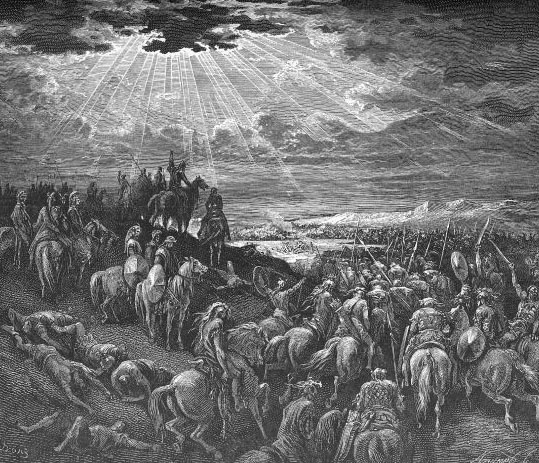
As I was reading a familiar passage today, I was struck by seeing it in a new way. The passage in question in Joshua 10:1-27, which includes the battle between the five Amorite Kings and the miracle of the Sun standing still. What caught my eye were some of the connections between this story and the crucifixion of Jesus. Here are the connections I saw:
Now, the similarities are obviously there, but is that all they are-similarities? Could these five Amorite Kings be types pointing us forward to Jesus? We definitely have to be careful here, and I’ll be the first to admit most people think I’m too heavy on typology, but there does seem to be textual warrant linking this episode to the death of Christ. How would we find a typological link between the evil kings, and Jesus the Messianic King? We must understand that every type does not have to be a positive one. A “type,” in regards to biblical typology, is something or someone which points forward to something in the future (an “anti-type”), most often, if not exclusively, Jesus and his life, ministry, death, and resurrection. Biblical typology demands that the type must have existed or occurred in history (i.e., have actually happened), there must be a textual link between the type and anti-type (in our example so far, the link is in the similiar events), and there must be escalation between type and anti-type (the fulfillment is always bigger and better than the type). In Joshua, there are positive links between the two: both include cosmic signs (though they differ in what kind of sign between the sun stopping and the sun “going out”), the death of a/several king/s in such a way that considers them cursed by God, their burial at the end of the day in a closely guarded tomb in a cave, which is sealed off by a/some rock/s. But there also appears to be some negative or antithetical typology which makes seeing the links more difficult. The main issue here is that the five Amorite kings are evil, hence why God is judging them through the Israelites. In fact, as my friend Tyler Whitman mentioned (primarily in agreement) via twitter, the text mentions them placing their feet on the necks/heads of the kings. This seems like an odd detail to mention, until we realize that it is a theme throughout the Old Testament which includes such violent imagery as breaking the teeth or crushing the heads of God’s enemies. The images would conjure up the promise of Genesis 3:15 where the Messiah was to crush the head of the serpent. These acts and images are always against God’s enemies, placing them squarely on the side of the serpent, and through the imagery of head-crushing, the Israelites were playing out the future victory of the Messiah. So how could Jesus be linked to these kings who the narrative says were on the side of the serpent? I can think of two ways to look at this issue. First, typology does not need to hinge upon every narrative detail (and in fact, it usually doesn’t). What this detail appears to do in the narrative is to remind the Israelites that God is fulfilling his promise of giving them the Promised Land, which was to serve as another Eden until Messiah returns to bring them back into Eden for good. The echo of Genesis 3:15 is apt, and makes sense in this regard. But, second, the first point may in fact be the typological link to Jesus. It would be an antithetical link to Jesus, in that the kings were being judged for their sin and rebellion (landing them squarely on the side of the serpent), while Jesus came under God’s judgment undeservingly—as one on the side of the serpent for those on the side of the serpent (e.g., you and I). In the act of crushing the serpents head, Jesus himself had his head crushed. Beyond this connection, however, notice that the end result is the same and we see the sense of escalation mentioned above. As Joshua and Israel stand victorious in their conquest of the king, their victories opened up the path into gaining control of the Promised Land, the land of abundance which served to remind them of the promise of Eden. When Jesus was crushed in our place, and proved God victorious in the resurrection, he too was leading exiles into the Promised Land. Only, these exiles were not slaves to Egypt heading for Canaan, it was you and I, slaves to sin, who were rerouted from Canaan to the true Eden where God rules and reigns over all and promises to exist among his people forever. I know that there are many different views on typology, and that I’m a bit typology heavy as I said earlier, but despite my own tendencies, there does seem to be a thematic link here. What are your thoughts? Filed under: Scripture Lessons, Theology         | ||||||||||||||||||
| You are subscribed to email updates from Modern March | church theology culture To stop receiving these emails, you may unsubscribe now. | Email delivery powered by Google |
| Google Inc., 20 West Kinzie, Chicago IL USA 60610 | |


Post a Comment